Visual Learner: Introduction


Welcome to Visual Learner. This is the book's introduction. Chapter One will follow on January 6. Subsequent chapters will be released once a month, occasionally doubling up so the book can be fully published in one calendar year. I used a substantial part of this introduction in a previous post just a few months ago. Apologies to my regular readers.
My senior year English teacher was friends with my parents. She passed away three years ago, which caused me to reflect on her class. I was not and am not a gifted literary critic. I do not know that I am a gifted critic of anything, but that has not stopped me from being critical. “I’m a visual learner!” Man, I wish I had that phrase in my back pocket in high school. I proved my inadequacies repeatedly in her class. My observations on Hamlet were unique…and not in a good way. My interpretations of fiction are usually out of bounds. We had to write a paper about a poet. I wrote about Bob Dylan because, as a 17-year-old with a raging case of senioritis, I did not want to search for another poet and read a large sampling of their work. My teacher told me I would have to prove Dylan was a poet. I think I wrote one line about Tarantula and focused my efforts elsewhere. (1)
Despite my subpar Dylan paper and complaining that I would rather read Henry V than Hamlet, my English teacher told my parents I should become a writer. I was flattered by that and at least knew I would get a good grade in the class, but I quickly dismissed the idea. There were reasons. I did not read that much and suffered from poor recall. I had friends who wrote as a hobby, and they were much better. I did not know what I would write about. I possessed the vocabulary of a 4th grader.
I put my teacher’s career suggestion aside and registered for art classes. My rationale was that writing was a significant undertaking, and I was not up for the task. It would take me a long time to understand that most people are not qualified for their jobs. Night after night, I would watch David Letterman bomb one joke after another during his opening monologue, and it never occurred to me, “Hey, maybe the people writing these jokes aren’t funnier than everyone else. Maybe they just decided that’s what they wanted to do and went for it.” Instead, I thought, “A writer? I can’t be a writer. Ernest Hemingway was a writer.”
Signs continued to appear, and I continued to ignore them. Upon entering college, my freshman composition class collectively lobbied my professor to give me an A instead of a B+ for a writing assignment. This was not proposed as a debate. That is not how grades work. My professor read my paper to the class. Why? I don’t know. Someone said, “What grade did that get?” He said, “I gave it a B+.” Please understand that as a teacher, you don’t tell the entire class what one student received for an assignment. What followed was a “peas and carrots, peas and carrots” murmur in the class until someone said, “I think you should give that an A.”
“Yeah.”
“Me, too.”
“Yeah.”
The instructor changed the grade. "Cool," I thought. “But I need to get to drawing class." My drawing professor told us that he only gave As to students he thought would become artists. I received a B+.
I took Introduction to Drama. For our final project, we could choose between reviewing a theatrical performance or writing an original one-act play. I wrote a one-act play. My professor asked if he and some actors could perform it on the radio. Something happened, and the play was never performed, but the offer was there. Twenty years later, I found my instructor on Facebook, and the first thing he said was, “I’m so sorry we never got to perform your play.” I do not even remember the name of this play. I never wrote another one. I had to get to painting class.
Those were the wins (albeit minor ones) I had racked up for writing by the age of 21. But that is OK, considering I was not trying to write. My artistic successes until that point were getting rejected from a juried student art show and having an instructor make it a point to say to me in a room full of other art students, “I just want you to know that I didn’t like your work and I voted against you for the senior exhibition.” And my students wonder why I am so blunt and critical. Despite this, my mind said, “Art is your thing. Writing is a hobby.”
Why does this book exist? This book exists because of a playlist. Recently, I assembled a collection of songs under the generic heading of “Pop.” I added Duran Duran’s “Notorious” to the list, which was the first time I had seen the Notorious album cover in years. I never owned the album. It was released in 1986. At that time, I only owned four albums made after 1970: the Miami Vice soundtrack, the Back to the Future soundtrack, Michael Jackson’s Thriller, and The Outfield’s Play Deep. Three of those were gifts. I did not buy albums at that age. I listened to the radio, bought 45s, and made mixtapes of my dad’s record collection.
In the spring of 1986, my sixth-grade class was allowed headphones at school for certain times of the day. Even then, I listened to the radio. One day, I was admonished for loudly and accidentally singing, “Oh Nikita, you will never know anything about my home,” after being caught up in the tragedy of Elton John’s Cold War love story. (2)
Around this time, I remember a girl in our class sobbing uncontrollably. Duran Duran had broken up. The New Romantic Beatles were finished. Had the nonstop pace from 1981-1984 destroyed them? Was it the Live Aid concert of 1985? (3) This girl was distraught. There were not many boy bands to fall back on in the spring of 1986. Wham! would soon splinter. She was teary-eyed for the rest of the morning.
Duran Duran's demise occurred in the fall of 1985 or spring of 1986; however, they would release Notorious in October 1986. The band had not dissolved. The guitarist and drummer quit, but three were left standing. They regrouped with Nile Rogers and made a funk and horn-driven album like David Bowie’s collaboration with Rogers a few years earlier.
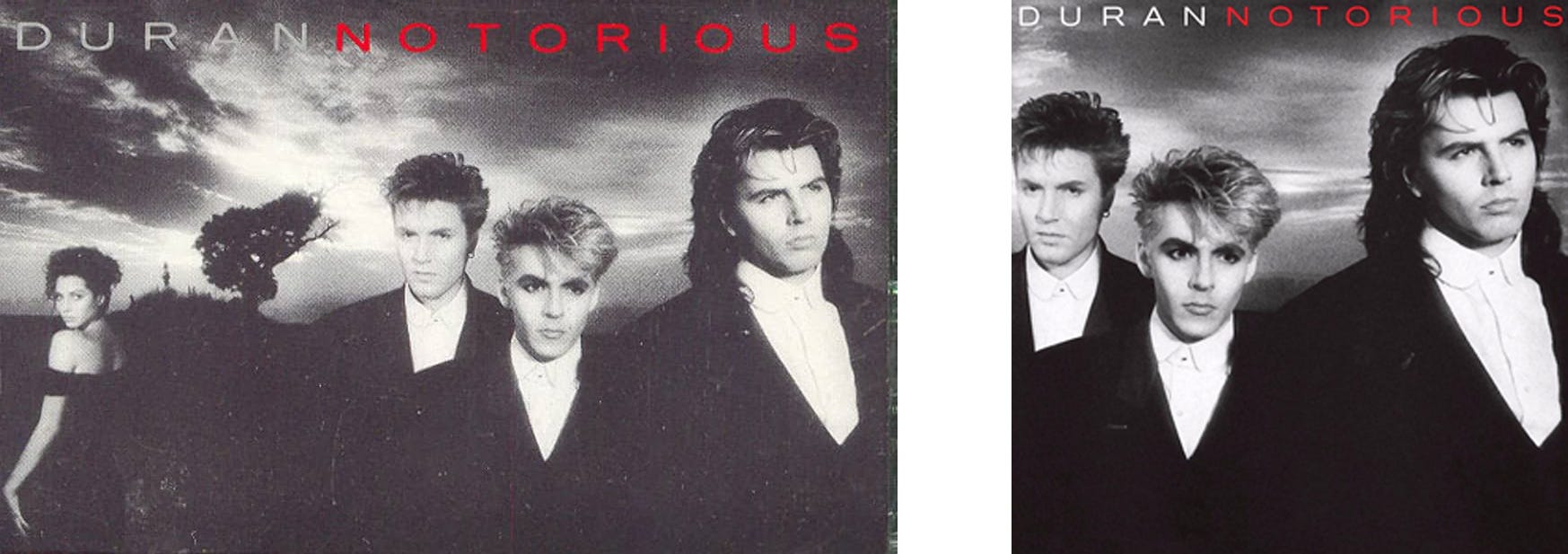
None of this is germane to the contents of this book. I had not thought of this moment until I saw the Notorious cover in my playlist. The memories came back to me at the sight of one image. But something about the image was wrong. It took me a minute to process, but the cover was incomplete. It was a square. I remembered the rectangular cassette. The cover, reduced to a square, features only the three remaining members of Duran Duran. The image on the cassette pushed the group to the right and revealed a desert landscape with Christy Turlington tucked away on the left.
Despite never owning this album, I vividly remember looking at it in a record store in Rivergate Mall in Goodlettsville, TN. Why would my brain register such a memory? I am highly susceptible to nostalgia, but this was not nostalgia. For a time, I kept a journal of when nostalgia overcame me. I have abandoned that project. This moment would not have been worthy of the journal.
After some time processing this, I decided it was a simple connection of an object to a moment. Memories attach to other impressions. With enough time, you could map your life as a web of nonlinear points. The brain draws a map of my life that cannot be charted simply by how one day precedes the following day. It connects points separated by years.
In his book, A Secular Age, philosopher Charles Taylor differentiates between “secular time” and “sacred time.”(4) Secular is linear and ordinary. It traps us. Sacred time reorders earthly time and introduces "warps" where "Good Friday in 1998 is closer in a way to the original day of Crucifixion than mid-summer's day 1997." This concept is holy for Taylor. It is for me as well, but I think most people's brains perform a small-scale version of that daily. If not, our sense of smell would not be a potent memory trigger.
This collection of essays lies somewhere between Duran Duran’s 1986 pop album and Charles Taylor’s 800-page analysis of the rise of secularism in the West. It is a deliberate mix of high and low art and reflects the intersection of art and life. I find it difficult to have a meaningful art experience that is not somehow reinforced by present circumstances or memories. A theoretical exercise is not going to keep my attention. The average art goer needs someone to tell them it is OK if that is how they come to art. I spend my days teaching people with no interest or experience in the arts how to find a way into a painting or sculpture. If a memory of an absurd situation gives you access, roll with that. Do not be intimidated. No musician or filmmaker demands you pass a test to engage with their art. Visual art should operate on the same dynamic. Your initial reaction may not be correct in how it interprets the art, but that is OK. You need a door to open. A little time spent with an object and some research will cover the rest.
Many of our most powerful memories are those of our youth. The first experience imprints itself deeply in the brain. Several of these essays unpack my childhood as much as they address works of art. If a person is going to connect with art, it will partially be rooted in childhood associations. When I used to give lectures or speak to audiences, someone would ask when I decided to be an artist. I gently pushed back that was the wrong question. At some point in their lives, everyone made art. The first piece of art I remember making was in preschool. My teacher made me dip my foot in white paint and make a footprint on green paper. Everyone makes art, whether by choice or force, even if you trace your hand on a piece of paper and make it look like a turkey. The question is not when I decided to be an artist. The question is, when did 99% of the population choose not to be artists? No one must be a full-time artist to be an artist. You need to make art. That is all. You do not need a college degree or a license—what a remarkable gift compared to every other pursuit.
Some of these essays started as blog posts on my website. I have edited and reshaped those essays. Ideas have been changed or removed, but more than anything, they have been polished by an algorithmic grammar editor. The rest of these essays are new. I wrote them in a short burst of energy. They are more chaotic and bounce around from one tenuous connection to another. That is how my brain works. That is my interaction with art. I think bouncing around is how all our brains work. Otherwise, we might not stop and take a deep breath because of an embarrassing conversation we had five years ago.
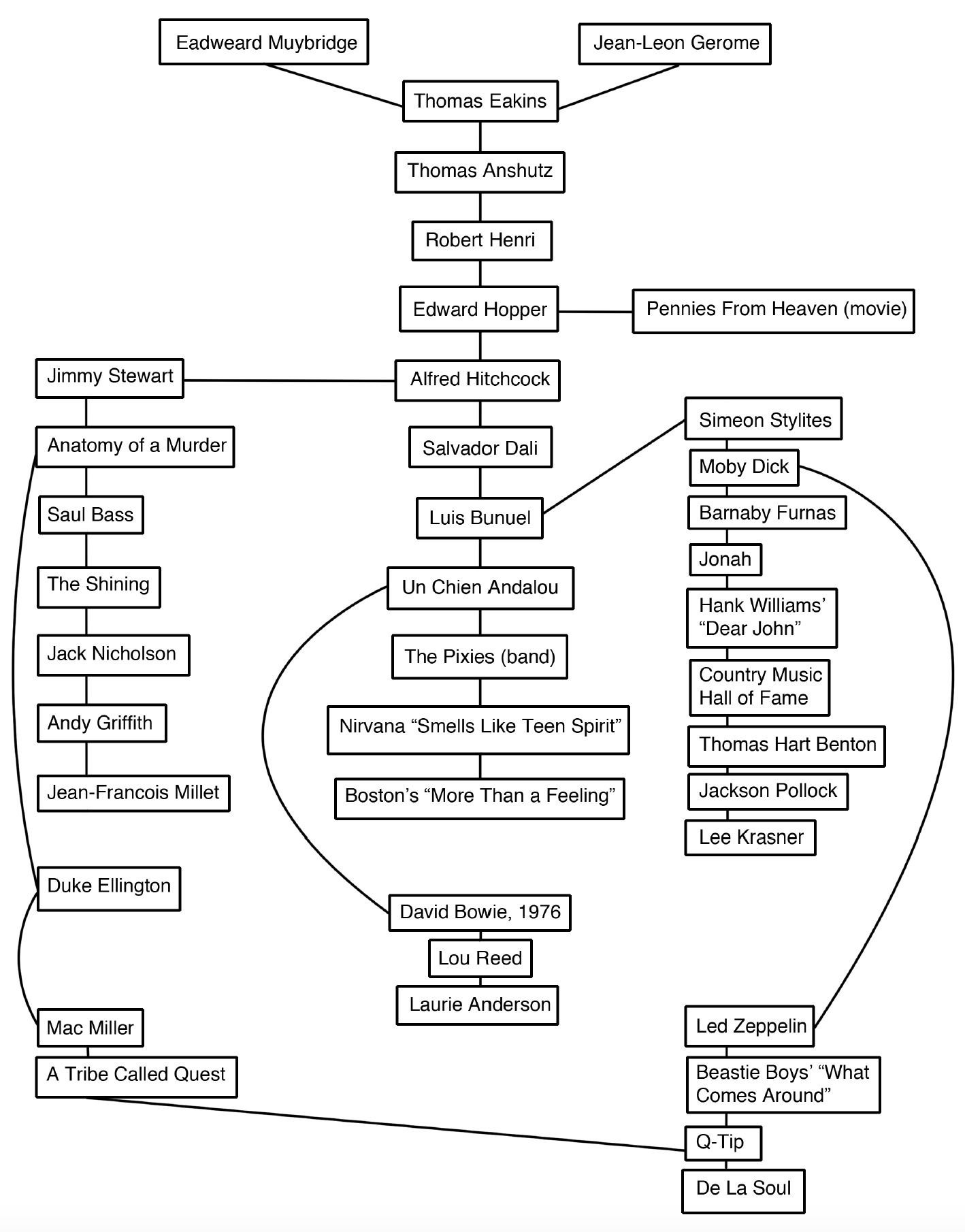
Students will occasionally ask for extra credit. I explain to them that they want extra credit because they failed to do their regular work and now want me to do additional work to help them repair the damage they have done to themselves. I will give them a worksheet if I am feeling generous or sympathetic. It is not difficult, but it is time-consuming. I have included the worksheet at the bottom of this post. It is a chart of boxes, each filled with a person’s name or a work of art. They must find the connections between boxes that touch. For example, explain how Moby Dick connects to Simeon Stylites and how Stylites connects to Luis Bunuel. Discovering connections is accomplished through internet searches. It appears daunting to my average student because, before my class, they had never heard of Luis Bunuel, did not know who Simeon Stylites was, and might not have read Moby Dick. I created the exercise to show how a person can connect seemingly unrelated things like A Tribe Called Quest and Jean-Léon Gérôme in a handful of steps. It is one more attempt to show them that they walk around in art daily, whether they can see it or not, so learn more and recognize more.
I gave this assignment to one student. When she returned it to me, she said, “This was exhausting. It was like being in your brain for hours.” That is such a great observation. The chart is my way of connecting these dots. It is my choice of subjects and how to join them. Everyone could make a diagram like this, but the boxes would contain different names and ways of connecting them. If I tell twenty people to draw an apple, I will get twenty drawings of an apple, and no two of them will be alike. This chart is no different. All art and its interpretation is a dialogue between receiving and projecting information.
These essays are a collection of connected dots. One piece contains a series of connections and points to others through repeated content, language, and ideas. Most of the dots were created 30-40 years ago. You will see that my childhood was not very dramatic. It was comical even when it was painful, but not dramatic. I did not write this book to exorcise bitter demons or reveal a traumatic history. None of that happened to me. I had a blissfully boring suburban childhood with no more than the ordinary mental, emotional, and physical bullying provided by boys and girls who were probably experiencing much worse things than me. Those stories are not included here but may pop up in future writings.
I am not sure who the intended audience is for this book. It is deliberately PG in subject matter and language. There is nothing salacious. There is only one curse word in the book. It falls in the essay “The Water Tower.” It is a direct quote, and the anecdote does not work without the word. Artists might read this collection and connect with my path into the art world. Art students can read it to get one perspective about the road they are walking.
There is nothing about professional development here, so do not read in anticipation of getting those questions answered. That is a different book. When I was in graduate school, we visited the studio of a well-known artist. He was a brilliant painter, still in his prime, even though he was 76. He led us on a generous studio tour and showed us works in progress. He then sat us down and summarized his career, noting that his first solo exhibition was at the Museum of Modern Art. A student asked, “How was your first solo show at MoMA?” The painter shook his head and said, “I don’t know. Who remembers these things?” I understand that you want these questions answered by someone. Maybe not me, but someone. None of that relates to the material in this book.
For better or worse, the people most prepared to understand this book are teenage suburban kids. They have a stronger connection to their childhood and understand what I am talking about. I spend many hours talking to and grading the assignments of people who have no relation to art. I want to build a bigger tent. I do not have a mission to turn everyone into an artist. I want people to reap the emotional and mental benefits of interacting with art- to reconnect with their humanity and the culture around them. This collection of writings is an anecdotal guide to art. It should demystify the art experience. You may not know this if you are an artist, but most people think art galleries are not open to the public. They believe that commercial art galleries charge admission. I have to explain that art galleries are like grocery stores. Kroger does not charge you money to enter to see if you want to spend more money. If you want to improve your art scene and get non-artists connected and engaged, you have a lot of heavy lifting ahead of you. Be generous. Assume nothing.
If you like these essays, thank my English teacher, Loy Martin. If you do not, the blame lies with me. Either way, thank you, Loy Martin, even if it took me over 30 years to hear from you.
Thanks to Adam Hill for reading these essays and for his suggestions. Check out his Substack.
Notes:
Tarantula is a collection of Bob Dylan's poetry published in 1971.
“Nikita” is an Elton John/Bernie Taupin song from 1985 from John’s album Ice on Fire. Fun fact: George Michael sings backing vocals on this track.
There is a debate about whether Duran Duran performed well at Live Aid. There was a growing tension in the band centered on the artistic development of the group. They are British, with one foot in the United States and one foot in Europe. Some band members were pushing for a harder rock edge, aligning them with where American tastes were headed. The others saw more value in Europe’s dance scene. If you watch their Live Aid performance of “The Reflex,” you will see the two elements working against one another: a synth-pop song overrun by a hard rock guitar.
Charles Taylor’s book, A Secular Age, was released in 2007. It is complex and dense. You can read various website summaries of the book or James K.A. Smith’s book, How (Not) to Be Secular: Reading Charles Taylor, for a good analysis of the book.
The following document is the previously mentioned extra credit sheet: